Tuesday, 10 December 2013

Where are they now? Josh Holbrook - Graphic Communication 2012

Josh studied Graphic Communication from 2010 - 2012 at Thomas Rotherham College.  His unit 4 portfolio can be seen on the ArtHive here. Thanks for the post Josh!
 
During my time at Thomas Rotherham college, I did Graphic Communication. After finishing College I went straight into University where I am doing my MArt of Games Design, and this is at Sheffield Hallam University.

The Graphics course prepared me for it as there is a lot of self-lead work, and independent tasks to do, as there isn't enough lecture time to do everything in University time, which is true for all courses, and we also use Photoshop a lot and there is a lot of drawing, which I spent most of my time doing at College.

My specific career aspiration is to be a Games Designer, and if the opportunity arises, I will go to America into large Games Studios.

Friday, 15 November 2013

Fun with the Art Department at Dinnington Primary School

On Thursday 24th October myself, Bev and Abi from the Art Department packed up the very heavy printing press and took 5 students to make some beautiful artwork with the children at Dinnington Community Primary School.  Georgia Keyworth, Rebecca Nichols, Hannah Zahir, Bronya Roberts and Chantelle Hillman took charge for the afternoon, inspiring the children and producing a piece of Artwork each for both TRC and Dinnington to keep.  Georgia has kindly written the piece below about our day out;

‘On Thursday the 24th of October we went to Dinington Primary School to do an art workshop with children in years five and six to hopefully make them enthusiastic about art. The work we decided to do was lino printing to show the children you can produce art work by using many different materials and how to experiment with different colours and fabrics. We wanted the end result to be a quilt in style of Tracy Emin with words stitched on it that the children have thought of when they think of art.
We were going to produce two quilts so that the school could keep one and so we could take one back to keep at college. We got the children into small groups so they could have one TRC student to help their table. Together each group came up with interesting words such as ‘phenomenal’ and ‘fabtastic’.  One of the aims of going to Dinnington School was to find out if the children enjoy doing art and if not we wanted to see if we could change their opinion as being creative can help in many aspects in life, so it was good to see them come up with such ambitious words.

Lino cutting can be quite dangerous so before starting them we gave clear safety demonstrations and instructions. Throughout cutting we made sure the children were being careful and to correct them when needed as well as this we made sure they felt confident and comfortable to ask questions. As well as this we ensured that all the children got involved as team work is also a very important skill.


 After having a small chocolate break and finishing cutting the Lino blocks it was time to start printing. While working in the groups we made sure everybody had a job from choosing the fabric, inking up the lino prints and rolling the press. We also made sure the children experimented with the colours as we took primary colours however once mixed they could make many new ones. We had two teachers alongside us helping with the press and with the quilt. Once all the letters were printed we allowed the children to choose were they would like the words to be placed as this was their work and we only gave our ideas when needed. After this we were able to show the children the end result and we took them back to college to stich on the words.


Once both quilts have been finished we will invite the children involved to come into college so we can present them with their fantastic and imaginative art piece they produced.‘


We would also like to say a big thank you to Abi Panozzo, an ex TRC Art student who is currently volunteering in our department for all her hard work preparing the materials and help on the day.

Thursday, 14 November 2013

Where are they now? - Miranda Jones, Fine Art 2013

Guest blog post written by Miranda Jones, all images appear with her permission.  Thanks Miranda!
University: University of Leeds

Course: Art and Design
My name is Miranda Jones and whilst I attended TRC I completed the Fine Art A-level in 2013.

After leaving TRC I went straight to the University of Leeds to study Art and Design (my first choice).

The program at TRC definitely helped prepare me for my University course. Once I arrived at University I was amazed at actually how much TRC had offered in terms of techniques and mediums and how lucky we were as students to have the opportunity to try out these things. I have met so many people who were stuck doing paintings for their entire A-level. TRC and especially the teachers helped so much in pushing me creatively and forcing me out of my comfort zone. At the time this felt hard but it has been very rewarding and means that now I can adapt to any brief or situation and come up with creative ideas that aren’t just the obvious – great for university!

Within the Art and Design course there are practical modules and then more academic modules. For the first year the practical modules include studio based work (self-explanatory), and a project based off campus at a place called Armely Mills.  At Armley mills we do a different challenge every week such as a photography challenge or a sculpture challenge. These challenges help us work towards a final piece that, at the end of the semester, will be exhibited at Armely Mills (a bit like the journal and final piece process at TRC). The academic modules include Fundamentals of Imaging and the History and Theory of Art. For these subjects you write essays and read a lot of books! It is intense but extremely worthwhile. The knowledge that you gain from the academic side adds so much to your practical work.

Personally, I chose this specific course because it had a mix of practical and academic elements. I describe myself as an academic artist and enjoyed the structure that this degree had to offer.

At the moment I do not have any specific career aspirations. I believe that University will help me explore my options in the visual arts career area. Though I do know one thing, I don’t want to be an artist. It may sound strange but I’d much rather work as a gallery curator or a pattern designer. With the course I’m on it gives you the opportunity to take an industrial year, this is where you find work placements (paid and voluntary) with companies. I am hoping to take this industrial year as it is extremely successful in getting students jobs or at least getting them contacts.


Here are some pictures from a life drawing class I attend every week and some lino prints I created from a workshop.


In terms of outside projects, I am now a volunteer for a Visual Arts organisation called Pavilion. Pavilion is based in Leeds and deals with contemporary art and its politics. As a volunteer I help out at the exhibitions they put on (and therefore learn invaluable skills about curatorship), get to meet their visiting artists, help with school groups and give talks about the art on display. It is a great opportunity to be part of the Leeds creative arts society and looks amazing on my CV!


Thursday, 12 September 2013

Results and Destinations 2012/13!!!

Well done to everyone in the Art Department, the results this year have been fantastic with a 100% pass rate across all courses and levels,  We are extremly proud of the work produced by our students, their hard work has definately paid off.  Here is a break down of the results and where our students have have ended up this year:


A2 Fine Art:

We had an astounding 87.5% high grades (B-A*) including 11 A*'s.

The A2 Art students have gone on to study a wide variety of subjects including:

Fine Art, Newcastle University (Grace)
Fine Art, Manchester University (McCaullie)
Architecture, Cambridge University  (Joe)
Architecture, University of Sheffield (Vicky)
Landscape Architecture, University of Sheffield (Ngaire)
Photography, Sheffield Hallam (John)
Product Design, (Naomi)
Primary Teaching, Sheffield Hallam (Emily and Becky)

A2 Graphics:

We had a brilliant 62% high grades (B - A*) and again the graphics have gone on to do lots of different things:

Foundation course, RCAT (Emily, Sophie and Becky)
Architectural Technology, Leeds Met, (Eddie)
Business and Marketing (Becky)

The AS students also did really well, Fine Art achieving 71% high grades and Graphics Communication achieving 55%.  We cannot wait to see what these students produce in their A2 year!

Well done everyone!

Wednesday, 4 September 2013

Robert Rauschenberg - Screen Prints and Paintings

Robert Rauschenberg is a painter and multi media Artist from the twentieth century, he was one of the first 'Artists' to use the traditionally commercial medium of screen printing in Fine Art pieces, printing on a variety of papers and srfaces and using his prints in different ways:


Courtesy of Atom

Courtesy of Atom
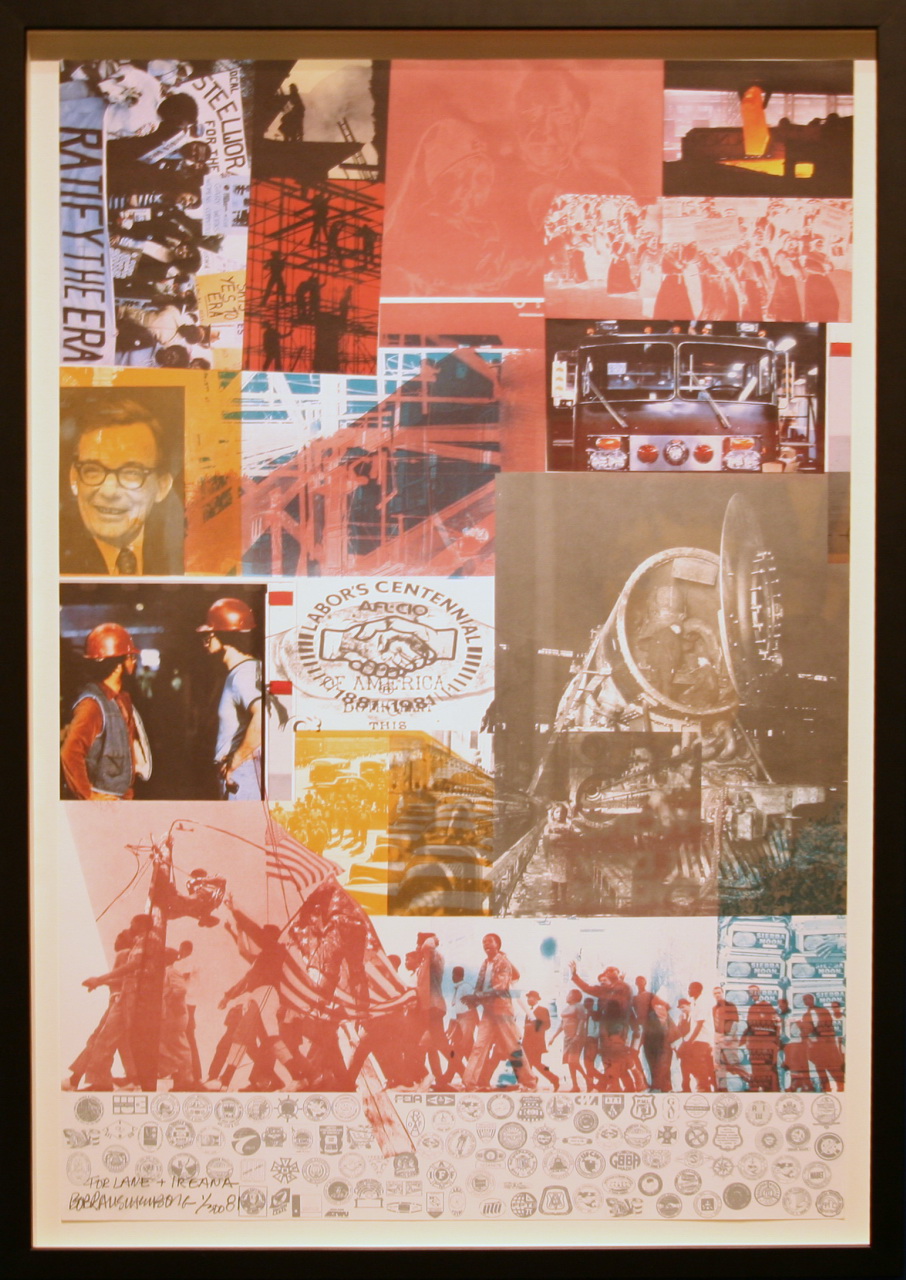
He also used another printmaking technique which is a different process, however the results can be similar to that of screen printing:
 
“Labor’s Centennial” Lane Kirkland. By Robert Rauschenberg. Offset lithographic poster, 1981. 91.4 x 61 cm (36 x 24 in.): In this 1981 celebratory anniversary poster, Robert Rauschenberg honored Lane Kirkland, president of the AFL-CIO from 1979 to 1995, highlighting his portrait in bright orange. In addition to strengthening the influence of the AFL-CIO, Kirkland made the organization’s resources available to sustain Poland’s Solidarity Movement, thus contributing to the collapse of that nation’s Communist regieme
Courtesy of Cliff
Brake, 1969, Lithograph on paper by Robert Rauschenberg
Brake, which recognizes the contributions of Apollo 1 astronauts Virgil "Gus" Grissom, Ed White, and Roger Chaffee, was created in 1969 by Robert Rauschenberg as part of Stoned Moon, a lithographic series the artist devoted to the first lunar landing. Grissom, White, and Chaffee became the first American astronauts to lose their lives while on duty when their space capsule burst into flames during a training session in January 1967. The tragedy shook the nation and led to a reassessment of the space program. But the deaths of these space pioneers also reaffirmed the importance of continuing the moon shot, which culminated in July 1969 with the safe touchdown and return of Apollo 11. In a strange but fitting coincidence, the lower segment of the lithographic stone used to print Brake cracked during the proofing process. Rauschenberg embraced this chance occurrence and printed the stone in this fashion.
Courtesy of Cliff
He used his printmaking in many different forms, interpreting into 3D, collage, assemblage and sculpture:
 
Layered screen prints on clear acetate:

Overcast III, Rauschenberg 1963
Courtesy of cwphobia
"Last Turn Your Turn: Robert Rauschenberg & The Environmental Crisis" . Mahattan.
Courtesy of Marikeeler
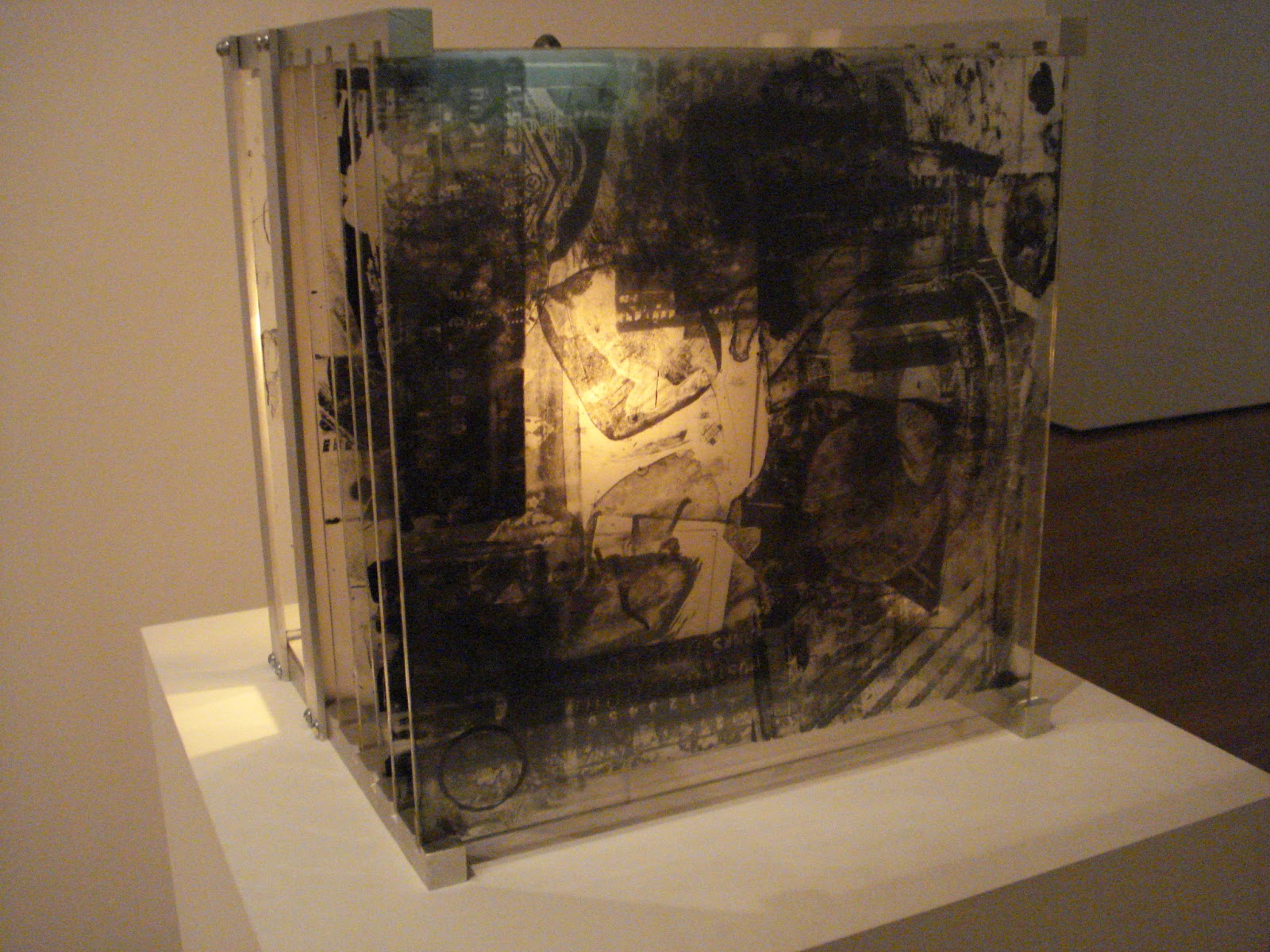
Layered scrren prints sculpture:

obert Rauschenberg piece at MoMA
Courtesy of Scott Bateman

Collage:


detail) Collection, 1954. Oil, newsprint, paper, fabric, found objects on canvas (1925-2008) SFMOMA
Courtesy of Rocor
Assemblage:

COurtesy of Rocor


Alberto Giacometti - Painting and Mark Making

Alberto Giacometti was a scupltor and painter who worked with thick oils and ink to create texture and depth in his work.  He is famous for his loose but considered mark making.


Courtesy of Globe Tripper

Portrait De Jean Ganet, 1955
courtesy of Claude Vallette


Miseria e splendore della carne
Courtesy of Il Fatto Quotidiano

Annette, 1950. Oil on canvas (1901-1966) MOMA. William Paley Collection. de Young Museum
Courtesy of Rocor

Caroline, 1961, Alberto Giacometti
Courtesy of Bob

Caroline, 1961, Alberto Giacometti. by pirano

Courtesy of Jasmined
 You can see Giacommetti working on the early stages of one of his paintings in this video:


Here are some images of his sketchbooks:

Henry Moore - Shelter Drawings

Henry Moore is an extremly important 20th Century Artist most famous for his sculptures, lots of which can be seen at the Yorkshire Sculpture Park.  However, he is also did a series of drawings of underground bomb shelters during the second world war. Here is a video of Henry Moore talking about the expeirence of creating these drawings:

http://www.bbc.co.uk/learningzone/clips/henry-moore-s-underground-shelter-drawings-from-world-war-ii/11626.html

To create the grainy texture which mirrored the half light of the shelters he used a technique using wax and ink:

28th July 1945: 'Four Grey Sleepers', by Henry Moore, a drawing commissioned by the War Artist Advisory Committee. Original Publication: Picture Post - 1970 - Henry Moore - Sculptor - pub. 1945 (Photo by Picture Post/Hulton Archive/Getty Images) Copyright Getty Images


 By Crossett Library Bennington College

Image Courtesy of The Henry Moore Foundation
 Moore was influenced by the drawings of August Rodin who again is more famous as a sculptor, but made drawings of his own work and as studies before making sculptures using a similar technique:

Auguste Rodin, Mother and Child, c.1880
graphite, pen and ink, wash, gouache on paper
950 x 174 mm
Image courtesy of the Musee Rodin via the Henry Moore Foundation


Rodin Drawin courtesy of Wanted in Rome
 Moore made drawings of his sculptures in the same way:


Henry Moore - Reclining Figures - Ideas for Stone Sculpture (1944)
couresty of Cea
You can see the textures and surfaces of his drawings visually link with the textures and surfaces of his Bronze sculptures as they wear over time:

Henry Moore Conservation Day 8: Please don't climb on sculpture!
Courtesy of UK Parliament